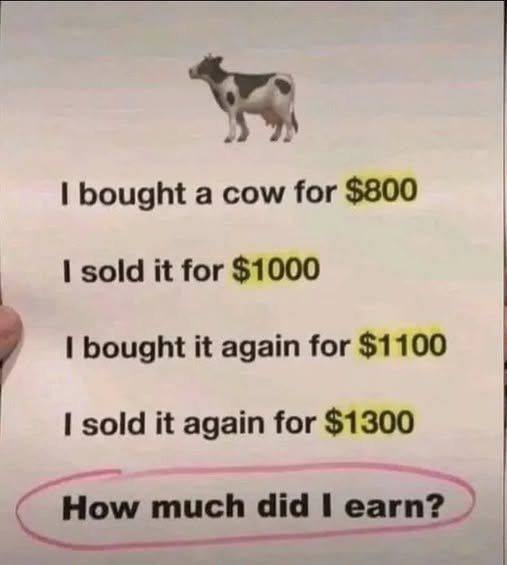

It all begins innocuously enough: a cow, four tidy numbers, and a deceptively simple question. At first glance, this looks like the sort of puzzle designed to make a math class glance up from their notes and nod. But appearances, as always, can be deceiving. The numbers are clean: 800, 1,000, 1,100, 1,300. There are no fees to worry about, no interest rates to calculate, no sneaky fine print hidden somewhere in the back of the problem. Just two purchases and two sales, like a story in miniature—a tiny marketplace that, if approached correctly, is entirely manageable.
And yet, the trap is not in the arithmetic. Anyone who has tried to solve this quickly will tell you that the real danger is cognitive. Our brains, when faced with multiple steps in rapid succession, have a tendency to overload, to treat sequences like tangled threads that must all be pulled at once. People see the first buy, see the second buy, then see the sells, and suddenly the neat little table of numbers warps into a blur. Confidence blossoms too early. Shorthand mental calculations replace careful reasoning. This is when you start hearing guesses like $0, or $200, or some other round number thrown into the ether as if certainty were obvious. And why not? It’s tempting. The numbers are neat, the problem is short, and our minds crave simplicity.
But the moment we try to compress every step into one massive, overarching formula, we lose track of what’s actually happening. We begin imagining that the second deal somehow cancels the first, that a subtraction here and an addition there will magically neutralize gains or losses. Our intuitive shortcuts fail, not because the puzzle is hard, but because we are trying to think in a way that our brains aren’t naturally equipped to handle without discipline. This is a puzzle about mental habits as much as math itself.
The solution emerges only when we slow down, when we stop trying to juggle everything simultaneously, and treat each transaction as its own story. Break it into bite-sized pieces. Begin with the first purchase: the cow costs $800. Then the cow is sold for $1,000. That transaction, in isolation, is simple. Spend 800, get back 1,000, and the net gain is $200. That’s it. Nothing more, nothing less. This is a self-contained episode: a tiny win that sets the stage for the next step.
The second transaction is equally straightforward: buy a second cow for $1,100, then sell it for $1,300. Follow the same methodical approach, ignoring any temptation to link it prematurely to the first. Spend 1,100, receive 1,300, and once again the net gain is $200. Nothing mystical occurs here; the profit is concrete, stepwise, and clear. Each deal tells a story of investment and return. Viewed this way, the mental fog begins to lift.
Now, once each story is understood individually, the final step is simply aggregation. Combine the two mini-profits: $200 from the first cow plus $200 from the second cow yields a total of $400. This is the correct answer, simple, elegant, and satisfying. Another way to verify this is by looking at the totals in a “zoomed-out” perspective. The total money spent across both transactions is $800 plus $1,100, which equals $1,900. The total money earned is $1,000 plus $1,300, which is $2,300. Subtract the total spent from the total earned: $2,300 minus $1,900, and we arrive at exactly the same $400. It’s reassuring to see that both micro- and macro-level approaches converge on the same result, a reminder that clarity emerges from careful, patient steps.
The real lesson here is psychological. Most of the difficulty does not lie in the arithmetic; $1,000 minus $800, $1,300 minus $1,100, these are calculations a third grader could do. The challenge is entirely cognitive: keeping multiple sequential steps distinct and resisting the brain’s instinct to oversimplify. This puzzle exposes how easily a perfectly solvable problem can feel confusing, and how quickly that confusion can snowball if we rush.
Indeed, it’s a story about certainty itself. Many who encounter this problem initially feel confident, even certain, that the answer must be either zero or a small, rounded number like $200. There is a kind of cognitive arrogance that comes from assuming patterns in sequences before they are fully understood. And then, upon realizing the error, there is relief, satisfaction, and a subtle cognitive recalibration. The mind learns something about its own limits: that even tidy numbers can be treacherous if we don’t respect the sequence of steps.
We can also reflect on why this puzzle resonates so widely. Beyond its immediate numerical clarity, it mirrors real-world situations. Investors, entrepreneurs, and decision-makers regularly face sequences of gains and losses. The natural human instinct is often to look for an “overall net” immediately, to compress multiple outcomes into a single, sweeping judgment. Mistakes are made not because the math is impossible, but because mental shortcuts fail under the weight of sequential complexity. In this sense, the cow problem is a microcosm of larger economic reasoning, teaching patience, methodical thinking, and respect for stepwise processes.
One could even extend the metaphor. Each cow represents an investment, each sale a return, and each step a choice. By approaching decisions methodically—treating each investment as a mini-story and calculating its individual return—we not only reduce errors, we also train ourselves to see patterns in a non-intuitive way. Complex situations, whether in finance, logistics, or daily life, often benefit from this stepwise clarity. It is a lesson in decomposing the problem, in acknowledging that our brains, while brilliant, are prone to misfire when overloaded.
And so, while the puzzle’s answer is technically trivial—$400—its significance is deeper. It highlights a fundamental principle: clarity emerges from careful observation and deliberate pacing. By isolating each step, we can cut through the noise of our own overthinking. We see that the problem is not in the numbers themselves, but in the way we process them. The puzzle is a gentle reminder that many challenges in life are similar: by slowing down, breaking the task into manageable pieces, and treating each component as a story, we can arrive at truth without confusion or anxiety.
In the end, the cow-and-numbers puzzle is as much a lesson in mental discipline as it is in arithmetic. The correct answer, $400, is the reward for patience, structured thinking, and step-by-step reasoning. The twist isn’t the sum itself—it’s the revelation of how easily confidence can be misplaced and how quickly clarity returns when we respect the sequence of actions. It is a miniature meditation on human cognition, a testament to the value of slowing down in a world that constantly urges us to rush. It teaches us that some problems only reveal themselves fully when we allow ourselves the simple grace of methodical attention, and that even straightforward scenarios can become opaque if approached with haste.
This humble puzzle, featuring a cow and four clean numbers, therefore carries a message that extends far beyond arithmetic: slow down, respect each step, separate the stories, and the solutions—both numerical and personal—become clear. And in a world that constantly seeks shortcuts, that is a lesson worth remembering.