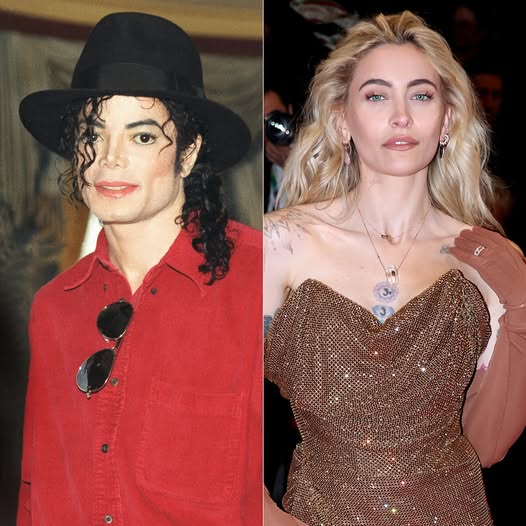

For much of her early life, Paris Jackson existed in the public imagination as a symbol rather than a person—a child glimpsed behind veils, standing beside Michael Jackson, protected from a world that both idolized and scrutinized her family. Her upbringing at Neverland Ranch was often portrayed as surreal, even mythical. But behind that image was a carefully controlled environment shaped by privacy, protection, and the immense weight of global attention.
As she has grown older, Paris has gradually stepped forward to define herself on her own terms. Her story is not one of a single narrative, but of layered experiences—grief, identity, struggle, and recovery—shared with increasing openness over time.
A Childhood Marked by Protection and Loss
Paris has spoken about her father as deeply loving and protective, someone who tried to shield his children from the harsher realities of fame. That protection, however, also meant a life largely removed from ordinary experiences. When Michael Jackson died in 2009, the transition was abrupt and profound. At just eleven years old, she lost not only a parent but also the structure that had defined her world.
In the years that followed, she entered a very different environment—one where public attention intensified rather than faded. The shift from privacy to visibility came at a time when she was still processing grief, and she has described that period as emotionally overwhelming.
Mental Health, Trauma, and Openness
As an adult, Paris has chosen to speak candidly about her struggles with mental health. She has discussed experiences with depression, substance use, and periods of self-harm, framing them not as defining features of her identity but as chapters in a longer process of healing. Her willingness to address these issues publicly has resonated with many who see aspects of their own struggles reflected in her story.
She has also shared that she experienced a traumatic assault as a teenager—something she revealed years later. By speaking about it, she has emphasized the importance of confronting difficult experiences rather than burying them, while also encouraging others to seek support in their own ways.
Her tattoos, which cover much of her body, are often described by her as personal markers—symbols of moments, memories, or turning points. Rather than hiding past pain, she has chosen to reinterpret it, turning visible reminders into expressions of control and identity.
Questions and Beliefs About Her Father’s Death
One of the more controversial aspects of Paris Jackson’s public statements involves her personal beliefs surrounding her father’s death. Officially, Michael Jackson died from acute intoxication involving propofol and other sedatives, and his physician, Conrad Murray, was later convicted of involuntary manslaughter.
Paris, however, has at times expressed the view that there may have been broader forces or pressures involved. It’s important to note that these beliefs reflect her personal perspective and are not supported by the legal findings of the case. Still, they illustrate how deeply she continues to grapple with the loss and legacy of her father.
Building an Identity Beyond Legacy
In recent years, Paris has focused on establishing her own path. Whether through music, modeling, or acting, she has worked to separate her identity from the expectations tied to her family name. This process has not been about rejecting her past, but about expanding beyond it.
She has also become an advocate for mental health awareness, often emphasizing honesty, vulnerability, and the importance of seeking help. Her approach is not polished or idealized; instead, it leans into complexity, acknowledging that healing is rarely linear.
A Story Still Being Written
What makes Paris Jackson’s journey compelling is not just the challenges she has faced, but the way she continues to navigate them. Her life reflects the intersection of public legacy and private experience—where global narratives meet deeply personal realities.
Rather than fitting neatly into the role once assigned to her, she has reshaped it. She is no longer simply viewed through the lens of her father’s fame, but as an individual working through grief, growth, and self-definition in real time.
Her story doesn’t resolve into a single message or conclusion. Instead, it remains open—evolving with each step she takes, and grounded in the ongoing effort to understand who she is beyond the headlines.