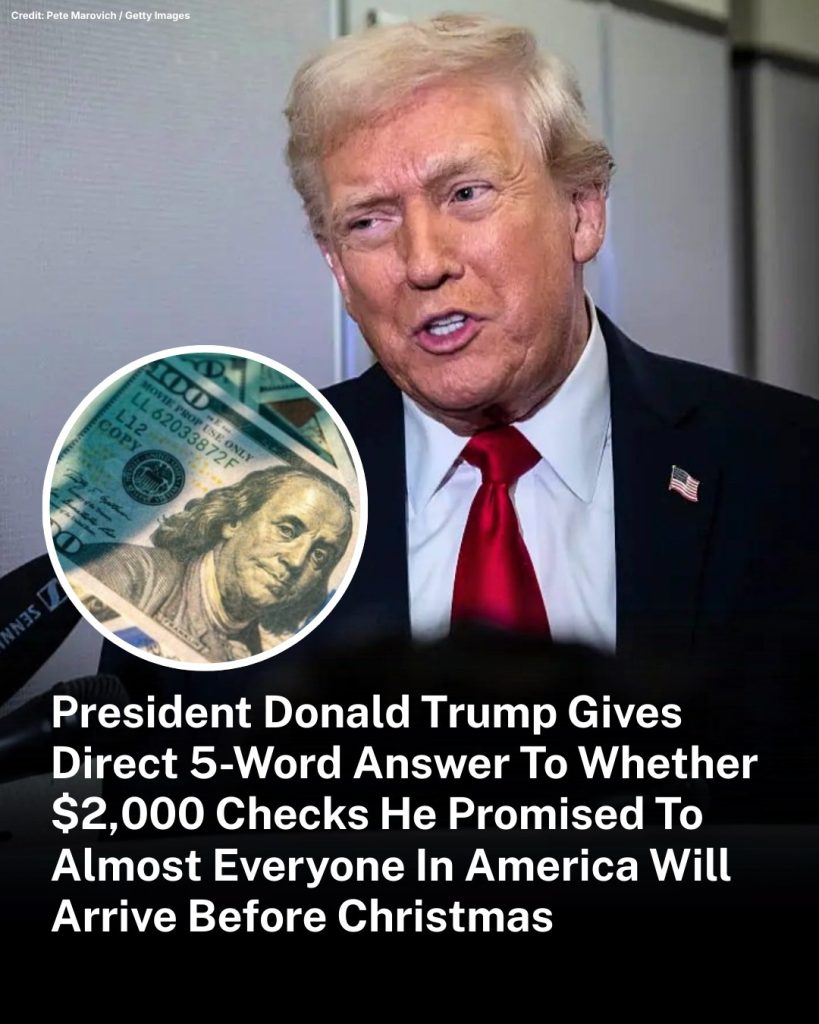
President Donald Trump has revived public debate over economic relief by proposing a potential “tariff dividend” — a one-time payment of $2,000 to Americans he describes as “moderate-income earners.”
The idea, still conceptual, aims to distribute part of the federal revenue generated by import tariffs directly to households. But for now, families hoping for extra cash this Christmas should temper expectations: Trump confirmed that no payments would arrive before 2026, likely closer to the midterm elections.
“We’ve taken in hundreds of millions of dollars in tariff money,” Trump said, explaining that the funds would be divided between paying down national debt and providing “dividends later on… of thousands of dollars for individuals of moderate income.”
How the Proposal Would Work
Unlike traditional stimulus checks funded through broad federal spending, the proposed tariff dividend would draw from revenue collected on imported goods.
In theory, this would allow the government to return tariff income to taxpayers rather than expand public debt.
However, economic analysts remain skeptical about the numbers.
Tax Foundation senior economist Erica York noted on X that if eligibility were capped at $100,000 in income, about 150 million adults could qualify—bringing the cost near $300 billion. Yet, as of September 2025, total tariff collections stood at roughly $195 billion, far short of what would be required to fund a nationwide $2,000 payment.
Some officials have floated the idea of issuing payments based on projected future revenue, citing Treasury forecasts of roughly $3 trillion in tariff income over the next decade. But such projections are uncertain, especially amid trade tensions and market fluctuations.
Who Would Qualify
Trump has emphasized that the dividends would go to middle- and lower-income families, excluding high earners. While no formal thresholds have been set, economists often define:
-
Lower-income households: under $55,820
-
Middle-income households: $55,820–$167,460
-
High-income households: above $167,460
These ranges vary by region, with household size and cost of living shaping what counts as “moderate income.” For comparison, Trump’s pandemic-era stimulus checks phased out at $75,000 for individuals and $150,000 for joint filers, suggesting similar benchmarks may apply here.
Reality Check: Not This Year
Despite growing online buzz, there is no congressional approval or formal Treasury plan for a tariff dividend.
Trump reaffirmed last week:
“It’ll be next year sometime.”
That means Americans should remain cautious about viral claims or unofficial “sign-up” websites promising early access to payments.
Beyond Politics: A Test of Policy and Trust
The proposal raises broader questions about economic policy and public trust. Can tariff-based revenue truly fund direct aid without inflating consumer prices or deepening trade conflicts? And more symbolically, can such a plan bridge the divide between campaign promises and fiscal reality?
For now, the so-called tariff dividend remains an idea — part populist pitch, part fiscal experiment — that captures a familiar American hope: relief that feels personal, fair, and earned.
But until it moves from rhetoric to legislation, the only certainty is that no holiday checks are coming in 2025.