
Beneath the Weight of Concrete
The bridge does not simply cross the land—it dominates it.
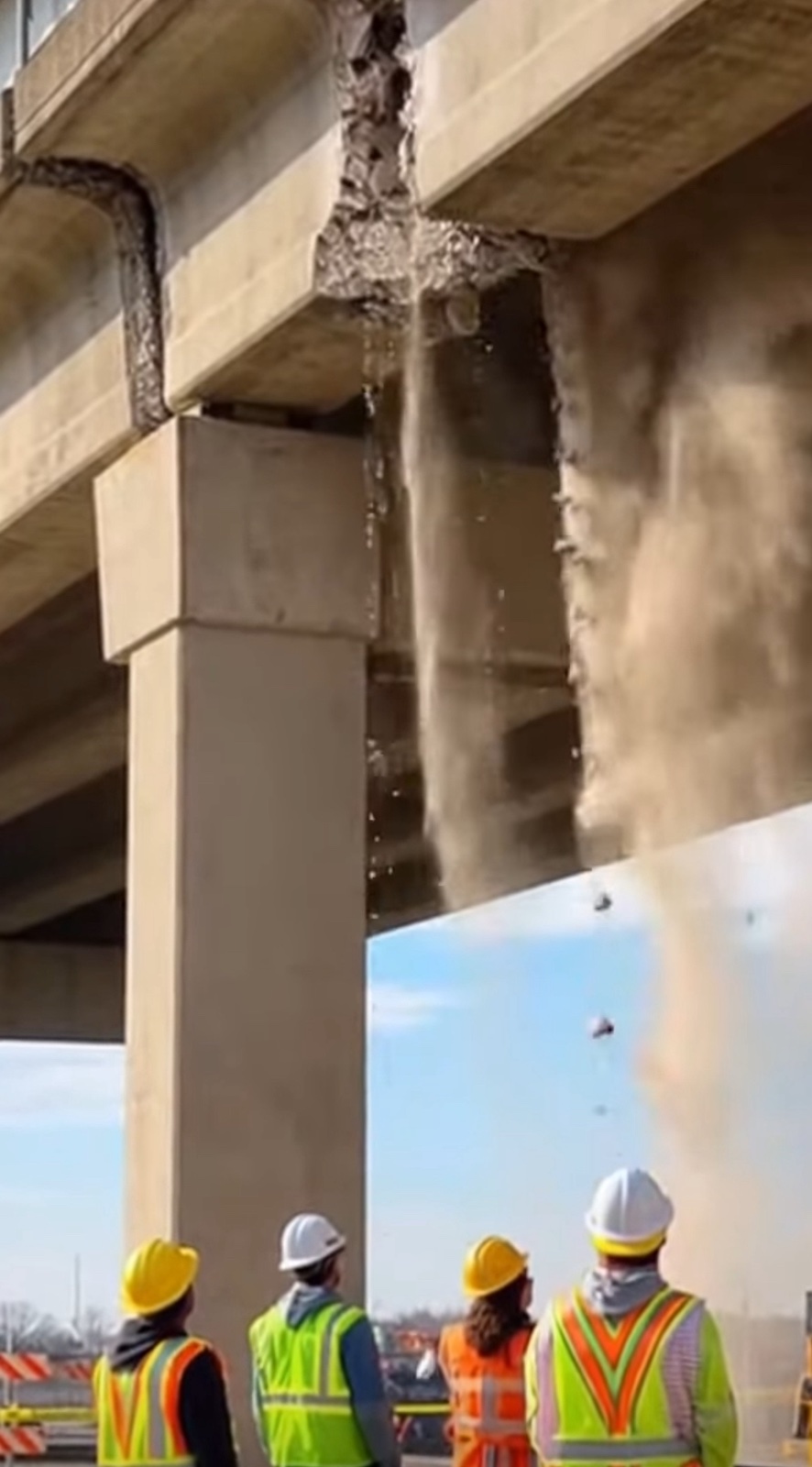
From below, it feels less like an object and more like a force of nature, a massive slab of concrete suspended in defiance of gravity, shadowing everything beneath it. The pillars rise from the earth like fossilized giants, thick and unyielding, their surfaces scarred with seams and stains that tell the quiet story of time, pressure, and weather. Above them, the roadway stretches outward, disappearing into pale sky, its underside a dark, oppressive ceiling.
This is a place of work, of industry, of urgency. And also, unmistakably, a place of danger.
The air is hazy, not with fog but with dust—fine particles of earth and concrete drifting slowly, catching the light and dulling the edges of everything they touch. The ground below is torn open, raw and brown, carved by heavy machinery and constant movement. Temporary barriers line the road, thick metal panels hammered into place, forming a narrow corridor where humans move carefully, deliberately, like ants navigating a crack in stone.
Men in high-visibility orange stand out sharply against the muted world around them. Their helmets gleam dully, scratched and worn, their reflective stripes flashing whenever light breaks through the dust. Some stand in small groups, others alone, all of them looking upward far more often than seems comfortable. Their attention is fixed on the underside of the bridge, where something has gone wrong—or is about to.
A crane extends its arm upward, yellow and rigid, reaching toward the concrete like a cautious hand. It holds still for a moment, as if listening, as if waiting for a signal that cannot be rushed. The operator inside the cab is unseen, sealed behind glass and machinery, trusting calculations and experience while gravity waits patiently below.
The bridge shows signs of strain. Cracks run through the concrete like veins, branching and irregular, not yet catastrophic but impossible to ignore. A section beneath the roadway looks damaged—fractured, partially broken, its edges jagged and uneven. The damage is not dramatic in the way explosions are dramatic; it is quieter, more unsettling. It suggests slow failure. Accumulated stress. A moment where tolerance was exceeded.
No one says it out loud, but everyone here understands the same truth: concrete remembers everything that has ever been asked of it.
This bridge has carried weight for years—cars, trucks, vibrations, heat, cold, wind. It has borne the impatience of commuters and the indifference of time. Now, beneath it, humans have gathered to correct something, to intervene, to keep a small flaw from becoming a disaster.
The road below is partially closed. Traffic has been pushed aside, diverted, delayed. Somewhere beyond the frame of this moment, horns may be sounding, drivers complaining about inconvenience, unaware of how fragile their usual certainty has become. From up there, the bridge likely feels eternal. From down here, it feels anything but.
The workers move carefully. One man gestures upward, pointing at a specific section of damage, his arm stiff, his movements precise. Another nods, adjusting his stance, boots pressing into the dirt. They speak in short bursts—technical language, warnings, confirmations. There is no room here for casual conversation.
Dust falls intermittently from above, small showers of grit cascading down when something shifts or settles. Each time it happens, heads tilt upward in unison, shoulders tense. The sound is soft but ominous, like sand pouring through an hourglass that no one can turn over.
The bridge creaks—not loudly, not dramatically—but enough to be felt more than heard. A low, internal groan travels through the concrete and into the pillars, down into the ground, where it vibrates faintly underfoot. It is the sound of weight adjusting itself, of materials negotiating their limits.
This is the moment where human engineering meets humility.
For all the calculations, all the blueprints and simulations, reality always has the final say. Wind behaves unpredictably. Loads shift. Materials age. A structure that once felt invincible develops weaknesses, hairline fractures that grow slowly, patiently, until they demand attention.
And now, that attention is here, wearing orange vests and hard hats, holding clipboards and radios, trusting cranes and cables and each other.
The crane begins to move.
Its arm lifts incrementally, almost imperceptibly at first, then more decisively. Steel cables tighten, humming with tension. Whatever it is supporting—reinforcing, stabilizing, or preparing to remove—responds with a subtle shift. The damaged section of concrete looks momentarily suspended between states: not fully supported by the bridge, not yet free of it.
Time stretches.
No one speaks.
The men on the ground hold their positions, eyes locked on the interaction between machine and structure. This is the critical moment, the point where theory becomes practice, where success and failure separate by inches.
The bridge does not collapse. It does not explode into chaos. Instead, it resists quietly, stubbornly, testing the limits of intervention. A small piece of debris breaks loose and falls, striking the ground with a sharp crack. Dust blooms upward in response, briefly obscuring vision.
Someone exhales loudly.
Work continues.
This is not heroism in the cinematic sense. There is no dramatic soundtrack, no slow-motion leap away from disaster. There is only patience, caution, and repetition. Adjust. Measure. Secure. Check again.
The workers’ faces—what can be seen of them—are focused, drawn. Sweat darkens fabric beneath their protective gear. The day may be hot or cold; it hardly matters. Their attention burns hotter than the weather.
Above them, the bridge remains massive and indifferent. It does not care who built it or who fixes it. It responds only to physics.
And yet, it is inseparable from human life.
Bridges are promises. They promise connection, speed, efficiency. They promise that obstacles—rivers, valleys, highways—can be overcome with enough ingenuity. When they work, they disappear into routine. When they falter, they remind us how much we rely on them.
This bridge, in this moment, is both.
It is still standing, still serving, but it is also wounded. Its vulnerability has been exposed, and with it, the vulnerability of those who depend on it.
The men in orange understand this better than anyone. Their work is not just about concrete and steel; it is about trust. Trust that the structure will hold after they leave. Trust that their repairs will outlast their presence. Trust that the people who cross above will never know how close failure once came.
As the crane steadies its load, as supports are adjusted and measurements confirmed, a fragile sense of control returns. The immediate danger recedes, replaced by the long, meticulous process of repair.
The dust begins to settle.
The bridge still looms overhead, unchanged in silhouette but altered in meaning. It is no longer just infrastructure. It is a reminder: of limits, of responsibility, of the thin line between stability and collapse.
Below it, humans continue their work—small figures beneath an enormous weight—doing what they have always done when faced with the consequences of their own creations.
They fix. They reinforce. They adapt.
And when they are finished, they will pack up their machines, remove the barriers, and leave. Cars will pass overhead again at full speed. The bridge will return to being invisible.
But for a brief moment in time, captured in dust and tension and concrete shadows, the illusion of permanence has cracked—just enough to be seen.