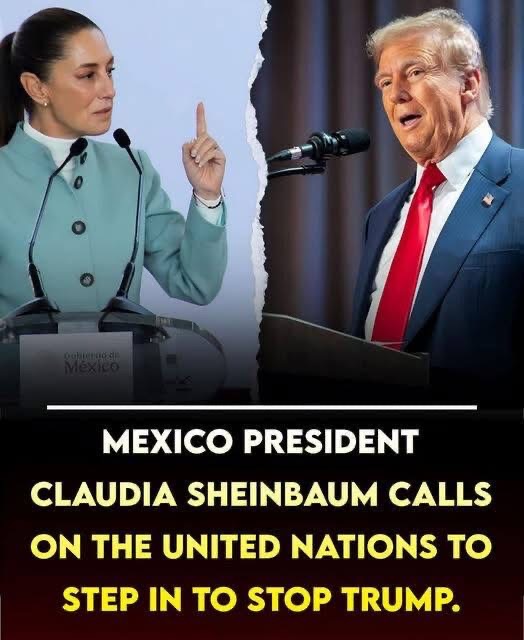

Mexico’s response arrived with unmistakable weight and urgency, signaling that what had occurred was not a routine diplomatic disagreement but a moment with potentially far-reaching consequences. In an unusually direct public statement, President Claudia Sheinbaum openly condemned the United States after reports emerged of a sudden military operation carried out on Venezuelan territory, culminating in the detention of President Nicolás Maduro. Such a rebuke was notable not only for its content but also for its rarity. Mexico has traditionally exercised caution in confronting Washington so publicly, especially on security matters, making Sheinbaum’s words all the more striking.
Rather than framing her reaction as a narrow conflict between two governments, Sheinbaum deliberately elevated the issue to the level of international law and global norms. Her remarks suggested that the operation in Venezuela was not simply an American decision with localized consequences but a direct challenge to the principles that underpin relations among sovereign states. By doing so, she repositioned the incident within a broader moral and legal framework, warning that the implications extended far beyond Caracas or Washington.
Central to her argument was the assertion that the reported U.S. action constituted a violation of foundational rules governing the international system. She specifically referenced Article 2(4) of the United Nations Charter, which prohibits states from using force against the territorial integrity or political independence of another country. This article, adopted in the aftermath of World War II, is one of the cornerstones of modern international law. By invoking it, Sheinbaum underscored that the alleged operation was not merely controversial but potentially illegal under the very rules that the global community has agreed to uphold.
At the same time, she grounded her criticism in Mexico’s own diplomatic tradition. She reminded the world of the Estrada Doctrine, a longstanding principle of Mexican foreign policy that rejects interference in the internal affairs of other nations and affirms the right of peoples to determine their own political destinies. This doctrine, developed in the early twentieth century, emerged in response to repeated foreign interventions in Latin America and has since become a defining element of Mexico’s international identity. By referencing it, Sheinbaum made clear that her stance was not improvised or opportunistic but deeply rooted in historical precedent and national values.
This dual appeal — to both international law and Mexico’s diplomatic heritage — strengthened the credibility of her warning. It also sent a signal that Mexico was prepared to defend these principles even when doing so risked tension with a powerful neighbor. Rather than aligning reflexively with U.S. strategic interests, Sheinbaum chose to anchor Mexico’s position in legality and ethical consistency.
Her message found a receptive audience across Latin America, a region where memories of foreign intervention are neither distant nor abstract. Throughout the twentieth century, many countries in the Americas experienced coups, regime changes, and covert operations supported or orchestrated by external powers, often justified in the name of security or ideological struggle. These episodes left deep scars, fostering a collective sensitivity to any action that appears to undermine sovereignty or impose political outcomes from abroad.
Against this historical backdrop, reports of a surprise military operation in Venezuela resonated as more than an isolated event. For many in the region, it raised troubling echoes of past interventions that destabilized societies and eroded trust in international norms. Sheinbaum’s statement tapped into these shared memories, articulating a concern that was widely felt but not always voiced so directly.
The reaction from Brazil and other influential regional actors reinforced the sense that Mexico’s unease was not an outlier. Expressions of concern from these countries suggested a growing recognition that the situation in Venezuela could set a dangerous precedent. If unilateral military actions against governments deemed problematic were to become normalized, the entire region could face increased instability and uncertainty. The issue, therefore, was not solely about the fate of Nicolás Maduro or the internal politics of Venezuela, but about the broader question of how power is exercised and constrained in the Americas.
As a result, the episode evolved into a test of diplomacy’s ability to prevent escalation. Could dialogue, multilateral engagement, and respect for international law prevail over force and unilateral decision-making? Or would this moment mark another step toward a more fragmented and volatile regional order? Sheinbaum’s intervention suggested that the answer to these questions mattered deeply to Mexico and its neighbors.
Beyond the immediate crisis, her remarks also served to define Mexico’s role on the global stage. In choosing to speak out, she articulated a vision of Mexican foreign policy that prioritizes legal norms and multilateralism over short-term political convenience. This was not merely a reaction to events in Venezuela, but a statement about how Mexico understands its responsibilities and values as an international actor.
Sheinbaum drew a clear boundary, signaling that Mexico would not remain silent in the face of actions it perceives as unlawful, even when those actions are carried out by a strategic partner. This stance required balancing principle with pragmatism, as Mexico maintains extensive ties with the United States in areas such as trade, migration, and security cooperation. By nevertheless issuing a public warning, she indicated that these relationships cannot override fundamental commitments to peace and sovereignty.
Her appeal to the United Nations further emphasized this point. By placing the crisis within a multilateral framework, she reinforced the idea that disputes of this magnitude should be addressed collectively, through established institutions and legal processes, rather than through unilateral force. The UN, despite its imperfections, remains a central forum for negotiating international conflicts and reaffirming shared norms. Sheinbaum’s insistence on its role highlighted her belief that global challenges demand cooperative solutions.
In this context, she argued that Venezuela’s future must be determined through diplomatic engagement and political processes, not imposed outcomes achieved through military action. This position aligned with a broader critique of interventionism, suggesting that external force often exacerbates conflicts rather than resolving them. By emphasizing diplomacy, she underscored the need for patience, negotiation, and respect for the agency of Venezuelan citizens themselves.
Her warning also carried an implicit message directed squarely at Washington. While cooperation between Mexico and the United States is essential on many fronts, she made clear that such cooperation cannot come at the expense of silence when core principles are at stake. Migration management, economic integration, and security collaboration are important, but they do not justify acquiescence to actions perceived as violations of international law.
This was a delicate but firm assertion of autonomy. Mexico, under Sheinbaum’s leadership, signaled that it seeks a relationship with the United States based on mutual respect rather than unquestioning alignment. By voicing her concerns openly, she aimed to establish that partnership does not mean abandonment of ethical or legal standards.
The broader implications of this moment extend beyond the immediate crisis in Venezuela. At stake is the question of how power will be exercised and constrained in the Western Hemisphere moving forward. Will international law serve as a genuine check on unilateral action, or will strategic interests continue to override legal commitments? Sheinbaum’s statement suggested that the answer to this question will shape the region’s future stability.
In framing the incident as a struggle over rules rather than personalities or politics, she encouraged observers to look beyond the headlines and consider the underlying dynamics at play. The capture of a single leader, dramatic as it may be, is less significant than the precedent it sets. If force becomes an accepted tool for resolving political disagreements, the norms that protect smaller and less powerful states are weakened.
Latin America’s collective response to this challenge may therefore prove decisive. The expressions of concern from Mexico, Brazil, and others indicate an awareness that safeguarding sovereignty requires vigilance and solidarity. By speaking out, these countries contribute to a broader effort to reinforce international law and discourage actions that could destabilize the region.
Sheinbaum’s intervention also highlighted the enduring relevance of principles articulated decades ago. The Estrada Doctrine and the UN Charter may originate in earlier historical contexts, but their emphasis on non-intervention and peaceful coexistence remains deeply pertinent. In invoking them, she demonstrated that these ideas are not relics of the past but living frameworks capable of guiding responses to contemporary crises.
Ultimately, her warning was about more than Venezuela or U.S.–Mexico relations. It was a call to reaffirm the rules that govern international behavior and to resist the normalization of force as a policy tool. By articulating this stance clearly and publicly, Sheinbaum positioned Mexico as a defender of multilateralism and legal order at a moment when both face significant strain.
The outcome of the crisis remains uncertain, but the significance of Mexico’s response is already clear. It has injected a principled voice into a volatile situation, reminding regional and global actors alike that power must be exercised within agreed limits. In doing so, Sheinbaum has framed the debate not as a clash of interests, but as a choice between law and force — a choice that will shape the future of the Americas for years to come.