 Tatiana crossed the threshold of the morgue at the very moment when the first silvery rays of morning slid across the concrete walls, as if announcing something unusual. Her shift had barely begun, yet within minutes everything around her turned into a scene worthy of a dramatic film. An ambulance pulled up in front of the building; its siren shut off abruptly, as though nature itself had frozen in anticipation. And then, as if by magic, an entire wedding procession appeared behind it: snow-white limousines adorned with fresh flowers and ribbons fluttering in the wind as symbols of hope, love, and happiness. But this time, happiness had arrived at the very doors of death.
Tatiana’s coworkers emerged from the morgue, drawn as if by a magnet to the spectacle. No one could believe what was happening: a wedding at a morgue was not just strange—it belonged to the realm of fantasy, almost a mystical event. The air hung heavy with silence, charged with anxiety and confusion. People whispered, pointed fingers, and some even pulled out their phones to capture the absurd moment. A shift change was underway, so a crowd had gathered outside: nurses, orderlies, pathologists, all in identical white coats, like ghosts watching as life invaded the realm of the dead.
Tatiana stayed apart. She leaned against the wall, half in shadow, as if afraid of being noticed. She had started this job only recently and had no friendly smiles or warm greetings behind her. Her colleagues glanced at her sideways, exchanged looks, but spoke little. Yet everyone knew—she had been in prison. No one said it out loud or asked directly, but whispers drifted through the corridors like fog: “She’s a killer,” “She served time for her husband,” “She was imprisoned for murder; now she scrubs floors.” Those words hung in the air like heavy drops before a storm.
Tatiana did not seek the spotlight. She only wanted to survive. To break with the past and start anew. But her past was not merely dark—it was filled with pain, loneliness, and cruelty. She spent six years in prison, serving a seven-year sentence for killing her husband. Not for theft, not for fraud, but for the desperate act of grabbing a knife to defend herself in a moment of extreme terror.
Her marriage lasted barely a year. The wedding was beautiful, like a fairy tale: white dress, smiles, champagne, toasts. But on the second day after the ceremony, her husband’s smiling mask fell away. He turned into a beast—rude, cruel, merciless. Tatiana was an orphan, raised in an institution; she had no family, no one by her side. Every day became torture. Beatings, humiliation, fear—that was her daily reality. And one day, when he raised his hand against her yet again, her mind snapped. The knife flashed in her hand, and everything ended.
The trial was harsh. The husband’s numerous and influential relatives demanded severe punishment. But the judge—an elderly woman with piercing eyes and a weary voice—said to the courtroom:
“For this, one does not send someone to prison. For this, one should say thank you. The world has been made cleaner.”
Tatiana received seven years. Six years later—parole. But the world outside the bars proved harder than the one inside. No one wanted to hire a former convict. Not cafés, not shops, not even cleaning jobs. All doors were closed. And purely by chance, passing by the morgue, she saw a notice: “Orderly needed. No experience required. Above-average salary.” Her heart tightened. It was an opportunity. She went in, told her story honestly, expecting rejection. But they hired her. No extra words. No judgment.
The work was hard. The first nights she woke drenched in cold sweat, hearing doors slamming and guards’ footsteps in her head. But little by little the fear faded. Especially after the words of the old pathologist, Piotr Efremovich—thin, gray-haired, his face carved with wrinkles like a map of life.
“You should fear the living, girl,” he told her with a smile. “These ones won’t touch anyone anymore.”
Those words became her mantra. She began to see the dead differently: not as ghosts, but as people who had already passed through pain, fear, and suffering. They were at peace. And she was still fighting.
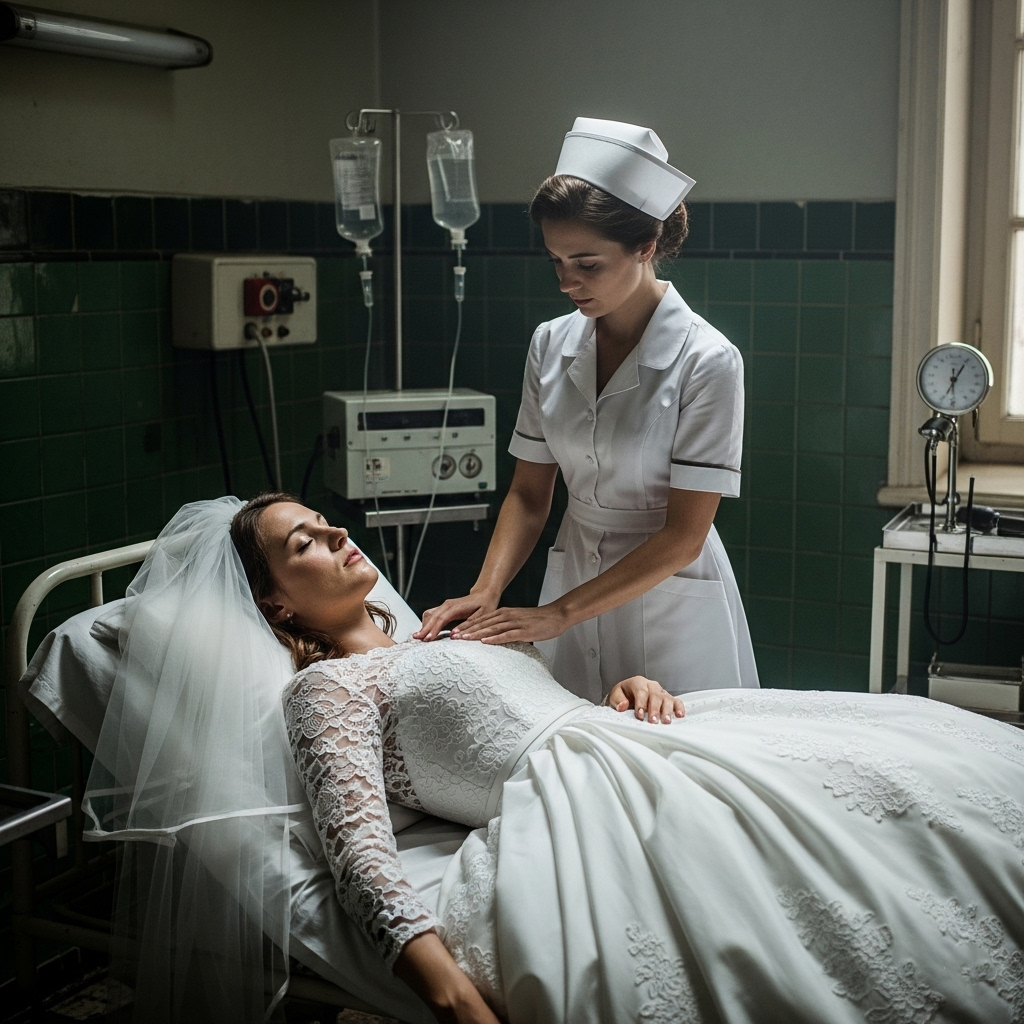
And now, on that strange day, they brought a bride into the morgue. On a gurney, covered with a sheet, flowers in her hands, wearing a wedding dress like a sleeping princess. Beside her stood the groom—young, handsome, but with eyes from which the light had gone out. He wasn’t crying. He was simply staring. His gaze was empty, as if his soul had already left, leaving the body standing upright. Relatives tried to pull him away, but he resisted like a man incapable of believing reality. When they finally took him away, he turned his head and looked at the morgue as if it were the gates of hell.
Tatiana overheard the orderlies talking: the bride had been poisoned by her childhood friend. The same friend who had attended the wedding, smiling with venom in her heart. It turned out the groom had once loved her, but then he met the bride—and everything changed. The friend couldn’t bear the betrayal, couldn’t accept being replaced. Now arrested, she had lost forever both love and friendship.
Tatiana passed by the gurney and froze. The girl was breathtakingly beautiful. Her face was not twisted by pain; on the contrary, it radiated calm, as if she were simply asleep. Her skin was fresh, rosy, like after a long rest. Something was wrong. A dead body doesn’t look like that.
“Tetiana, finish up in that room, clean here and close,” Efremovich’s voice interrupted her thoughts.
“Aren’t you doing the autopsy today?” she asked.
“No, I have to leave urgently. I’ll come early tomorrow.”
“Understood.”
“Good. These ones aren’t in a hurry,” he laughed. “They’ll wait.”
 His words made her think again. Perhaps working among the dead makes people philosophical. After all, here you face the end every day—and begin to value every moment of life.
When she finished cleaning, she went outside to get some air. The air was fresh, clean. And then she saw him: the groom. Sitting on a bench in front of the morgue, hunched like an old man. His silhouette seemed part of the night, merged with the twilight.
“Can I help you with anything?” she asked softly.
He slowly raised his eyes.
“Can you take me to her?”
“No, I can’t. I’d be fired. And no one would ever hire me again.”
He nodded, as if unsurprised.
“Why won’t they hire you?”
Tatiana looked at him and decided to be honest.
“I just got out of prison. I killed my husband.”
He nodded again.
“That’s sad. Haven’t they done the autopsy yet?”
“No. Tomorrow.”
“I don’t want to leave. When they bury her… maybe I’ll go too.”
“Don’t say that!” she exclaimed. “It’s hard, but you have to live.”
“I’ve already decided,” he said, turning away.
She understood: convincing him was impossible. But an idea crossed her mind—she had to notify his family. They needed to know what state he was in.
Back inside, she suddenly noticed the bride’s hand lying unnaturally. The body looked too… alive. Tatiana approached, carefully touched the hand, and stifled a scream. It was warm. Soft. Like someone who was sleeping. The morgue is always cold. Bodies should be icy. This was impossible.
She ran to her bag, heart pounding. She found an old, cracked mirror. Returning, she held it in front of the girl’s face. At that moment, it fogged up. Breathing. Weak, almost imperceptible—but there.
“Valera!” she shouted, running to a young orderly. “Come with me!”
Valera—smart, calm, former class representative at university—asked no questions. He saw the mirror, saw her eyes, and understood. He placed the stethoscope on the girl’s chest.
“The heart is beating,” he whispered. “Very weak, but it’s beating. Call an ambulance!”
Tatiana ran outside.
“Your bride is alive!” she shouted at the groom.
He stared at her, and for the first time that day, light flickered in his eyes.
“You’re not lying?”
“No! She’s alive!”
He sprang up like a resurrected dead man and ran toward the doors. At that moment, the gurney was being wheeled out.
“I’m coming with you!” he cried.
“Who are you?” the doctor asked.
“I’m her husband,” he whispered, breaking into sobs. “Today was our wedding.”
The doctor nodded; his voice was sharp but urgent, as if each word were torn from time itself:
“Into the vehicle, quickly. Every minute is a drop of blood that can’t be wasted.”
Sirens wailed, lights flashed, and the ambulance shot off, tearing through the morning silence like a blade through fabric. It disappeared around the corner, leaving only a trail of dust and an echo of hope. Tatiana and Valera remained, like two guards at the gate between life and death, staring in indescribable relief.
“Tetiana,” Valera said softly once his trembling hands finally steadied, “it seems you saved a human life today.”
He paused, choosing his words, then added:
“The doctor said that if not for the cold of the morgue, if the body hadn’t slowed its metabolism… she wouldn’t have survived. The poison was strange—not lethal, but a powerful sleep agent. So strong that breathing nearly stopped, the pulse became imperceptible. It wasn’t poisoning—it was… almost a simulation of death.”
Tatiana slowly wiped away tears that came on their own—not from fear or exhaustion, but from understanding: she had done what seemed impossible.
“Life for a life,” she whispered, staring into the distance. “I took one… and gave one back.”
Valera heard her. He didn’t judge. He wasn’t surprised. He only smiled—that warm, sincere smile one gives the dawn after a long sleepless night.
“Tetiana,” he said, “shall we have some tea? This place isn’t exactly cozy… but damn, today it became a place of miracles.”
She nodded. For the first time in many years, she felt she could simply… be.
“Outside?”
“Why not?” he smiled. “Right here, where it all began.”
They sat on the same bench where the devastated groom had sat earlier. Now it felt like a symbol of rebirth—as if the earth itself remembered that here, in this place, a lost hope had returned to life.
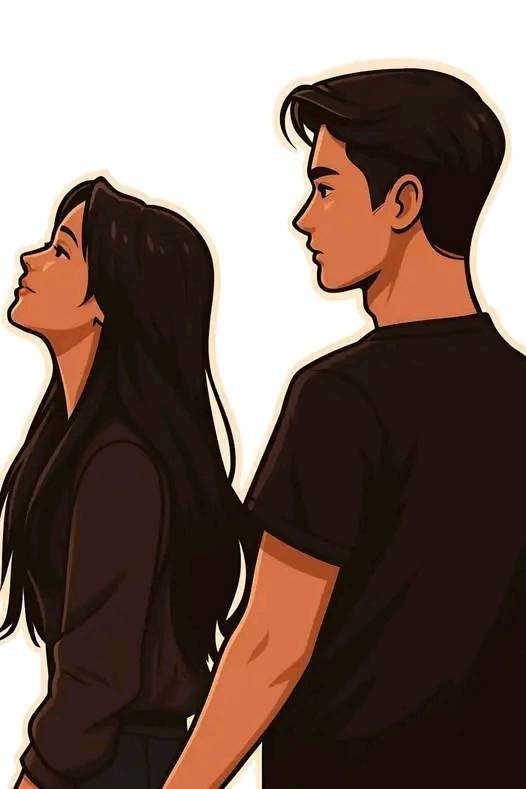
Sitting together, Tatiana looked closely at Valera for the first time. He seemed young, but up close the marks of years showed. His glasses gave him a student’s look, but his voice, gestures, and the lines by his eyes told another story. He wasn’t just an orderly. He was someone who had been through more.
“After military service I stayed on at a military hospital,” he began, stirring his tea. “I saw doctors work under fire. Save those who seemed beyond saving. I saw mistakes… but also miracles. Real ones. Tania, may I ask… what happened in your life?”
She was silent. The air grew heavy. But there was no judgment in his eyes—only a willingness to listen. And she spoke. Of the orphanage. Of the marriage that became hell. Of the raised hand for the hundredth time. Of the knife. Of the trial. Of six years behind bars.
When she finished, Valera said nothing banal. Not “I understand,” not “It wasn’t your fault.” He simply looked at her and said quietly:
“You don’t have to torture yourself over him.”
Tatiana stared at him in amazement.
“You’re the first to say that… to see me not as a criminal, but as a victim.”
Their tea grew cold, but their hearts did not.
Suddenly, an old but well-kept car pulled up by the morgue. Piotr Efremovich got out—gray-haired, cigarette at the corner of his mouth, dark circles under his eyes, but a living fire in his gaze.
“Well now, creatures, sitting around doing nothing?” he asked with a half-smile.
Valera smiled:
“In my practice, nothing like this: a ‘friend’ gave another not poison, but an ultra-strong sedative. If the dose had been a little higher, she’d never have woken up.”
Efremovich sighed deeply, looked at the morgue, and shook his head:
“Good thing I decided not to do the autopsy today. Otherwise…”
Tatiana looked at him, her heart tightening at the thought.
“I never imagined something like this was possible. That death could be a deception. That life could return.”
The next morning, she left the morgue feeling that something inside her had changed. She was no longer the one who only scrubbed floors, hid in shadows, and feared being seen. She was the one who saw breath where others saw only death.
At the bus stop, a car pulled up with a soft squeal.
“Tetiana, get in, I’ll give you a ride,” Valera’s voice called.
She froze. Those who had avoided her, whispered behind her back… now someone was offering help. She glanced back: the orderlies smoked by the morgue door, watching them with distrust and anger.
Valera looked in the rearview mirror and smiled.
“Do you care about their opinion?”
Tatiana hesitated. Then she got in.
Thus began their morning rides. Days turned into weeks. And one day, at the morgue entrance, Valera suddenly said:
“Tania, what if we go to the movies? Or a café?”
She shook her head.
“Why would you want that? You know who I am. That I was in prison.”
“And I fought,” he replied calmly. “I shot people. I killed. Not with a toy gun. Do you think I’m cleaner? No. We both went through hell. But now we’re here. And that’s what matters.”
That afternoon, while cleaning the corridor, Tatiana felt a warmth spread through her chest—not fear, not shame, but hope. She hadn’t said “yes” yet, but she was already dreaming of sitting with him in a small, cozy café, laughing, talking about simple things. She wanted to live. Truly.
Suddenly, a harsh voice came from the break room:
“Valera, are you crazy? What do you want her for? Playing games?”
“It’s my business,” he cut in. “And no one else’s.”
“You’ve lost your mind! She was in prison! Why do you need her?” the orderly insisted.
A minute later, Valera came into the corridor, rubbing his knuckles.
“Listen,” he said, staring straight at the provocateur, “one more word about Tania… and you’ll be the one in the morgue.”
The other man backed off, snorted.
“Everyone’s crazy here.”
Tatiana looked at Valera as he firmly took her arm.
“This can’t go on,” he said. “Tania, I like you. Truly. And I want to be with you. We need to change something.”
She was confused, wanted to say something, when suddenly a nearby voice rang out:
“What needs changing? You need to get married! We’ll throw a big wedding!”
She turned and saw them—the newlyweds. The girl, pale but alive, smiled radiantly.
“You have to accept,” she said. “You’re a wonderful couple. And we want to thank you. For giving me my life back.”
But Valera and Tatiana refused the lavish celebration. They were too mature; too much had passed to play dress-up.
“A simple ‘yes’ is enough,” Valera said.
So the newlyweds gave them a gift: a honeymoon by the sea.
“Have you ever seen the sea?” Valera asked.
“Never,” she whispered.
A few days later, Tatiana handed in her resignation.
“I’ll find something of my own,” she said.
“For now,” Valera smiled, “my job is to take care of you. To make you happy. To protect you.”
And when they stood on the shore, watching the waves crash against the sand, Tatiana felt for the first time in many years that she hadn’t just survived.
She had begun to live.
And the infinite blue of the sea seemed to whisper:
“You deserved it.”