
A Minor Misstep in a Hyper-Magnified World
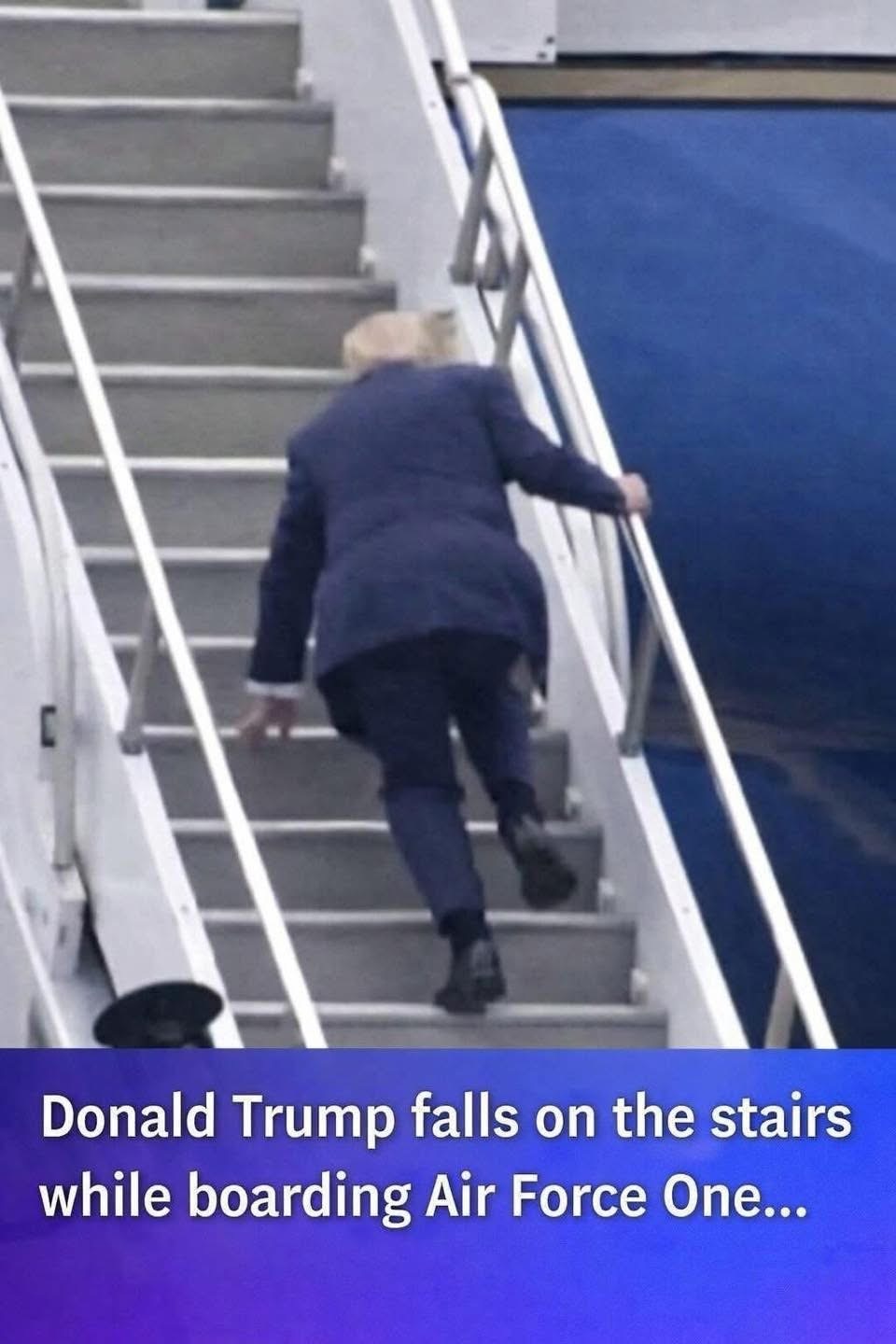
At times, history does not turn on grand speeches, decisive votes, or sweeping reforms, but on moments so small they would once have gone unnoticed. In today’s media-saturated environment, the line between the trivial and the consequential has become increasingly blurred. Ordinary human actions—especially when performed by public figures—are no longer allowed to exist in isolation. They are captured, replayed, analyzed, and transformed into symbols that carry far more weight than the moments themselves ever warranted. One such example unfolded when Donald Trump briefly lost his footing while climbing the stairs of Air Force One, a fleeting incident that quickly grew into a viral phenomenon.
The moment itself was unremarkable. Trump was walking up the aircraft steps, misjudged his footing for a fraction of a second, steadied himself almost immediately, and continued onward. There was no fall, no visible injury, and no interruption to the schedule. In another era, such a minor stumble would likely have been forgotten within minutes, remembered only by those physically present—if remembered at all. Yet in the modern age, where cameras are always rolling and digital platforms thrive on instant circulation, that second was preserved, duplicated, and distributed across the world within moments.
What followed was not a reaction to the physical event, but a response to what people believed the event represented. The stumble became detached from reality and reattached to narrative. Supporters dismissed it as a harmless, human moment that had been exaggerated for political purposes. Critics interpreted it as confirmation of long-standing arguments about age, fitness, or competence. Others used it as an opportunity to point out perceived hypocrisy, recalling past instances in which Trump had mocked political rivals for similar slips or physical missteps.
The speed and scale of the reaction revealed a deeper truth about the contemporary media ecosystem. Modern attention is driven less by importance and more by immediacy. Content that is visually striking, emotionally charged, and easy to consume is rewarded with visibility, regardless of its actual significance. A short clip—especially one that can be looped endlessly—often carries more influence online than complex policy discussions or substantive political developments. The stumble fit perfectly into this system: brief, visual, ambiguous, and ripe for interpretation.
Within hours, public discourse had shifted. Instead of discussing policy decisions, campaign strategies, or global affairs, conversations revolved around speculation. Commentators asked what the stumble “meant,” as though a momentary loss of balance required deeper interpretation. Was it evidence of physical decline? A sign of exhaustion? A metaphor for political instability? Or was it simply what happens when any person miscalculates a step? The very fact that such questions were posed illustrated how eager audiences have become to extract meaning from even the most insignificant occurrences.
Media coverage followed predictable patterns. Some outlets highlighted the incident with suggestive headlines, inviting readers to infer significance without explicitly stating it. Others criticized the coverage itself, arguing that the attention revealed more about the media’s priorities than about the subject of the clip. On social platforms, reactions were far more polarized. The video became a weapon in an ongoing cultural conflict, where every action is interpreted through a lens of allegiance or opposition.
Neutrality was notably scarce. Few responses simply acknowledged the moment and moved on. Instead, reactions tended to fall into extremes. Either the incident was aggressively minimized, framed as absurdly overblown, or it was dramatically inflated, portrayed as emblematic of larger concerns. This binary response reflects a broader trend in modern discourse, where nuance struggles to survive in an environment built for instant judgment and emotional reinforcement.
While this dynamic is not exclusive to Trump, his presence intensifies it. Few figures inspire the same degree of scrutiny or emotional investment. As a result, actions that would be ignored if performed by others—drinking a glass of water, descending a ramp, navigating stairs—become focal points of national conversation. The individual behavior becomes secondary to the narrative it can be made to support. The person is no longer acting; they are performing, whether intentionally or not, for an audience eager to interpret.
In earlier decades, such a moment would have faded quickly. News cycles moved more slowly, and editorial judgment acted as a filter between events and public attention. Today, that filter has weakened. Algorithms now determine visibility, rewarding content that generates engagement rather than understanding. Clips that provoke laughter, outrage, or mockery are promoted, while those requiring reflection are often sidelined. The stumble was tailor-made for this environment: brief enough to watch repeatedly, ambiguous enough to argue over, and emotionally flexible enough to fuel multiple narratives.
The public reaction also exposed a growing tendency to prioritize optics over substance. Instead of focusing on governance, leadership decisions, or political consequences, attention shifted to physical appearance and perceived symbolism. This shift does little to enhance civic understanding. Instead, it distorts priorities, encouraging superficial analysis at the expense of meaningful engagement. When minor physical moments dominate discussion, deeper and more consequential issues are crowded out.
Some observers noted the irony of the situation. Political leaders across history have stumbled, tripped, or momentarily lost balance. Such moments are not indicators of intelligence, capability, or leadership. Yet when filtered through partisan perspectives, they are transformed into tools of validation. The stumble was not truly about Trump’s physical condition; it was about how readily people were willing to use it to reinforce what they already believed.
Others suggested that the obsession reflected a kind of collective exhaustion. In an era marked by polarization and constant crisis, engaging with major political issues can feel overwhelming. Small, viral moments offer a simpler outlet. They allow participation without demanding depth. Watching, sharing, or commenting on a short clip requires no policy knowledge or historical context—only a reaction. In this sense, the stumble became a low-effort entry point into political discourse.
The incident also highlighted the selective nature of public outrage. Similar moments involving other leaders have been alternately ignored or amplified depending on who was involved and which audience was watching. This inconsistency reinforces cynicism and fuels the perception that media attention is shaped less by principle than by alignment. What is framed as alarming in one case may be dismissed as trivial in another.
Despite the volume of commentary, the stumble itself had no tangible impact. No decisions were altered. No policies were affected. No schedules changed. Air Force One departed as planned, and the machinery of governance continued uninterrupted. What lingered was not the event, but the reaction to it—a reminder of how easily public focus can be diverted toward the inconsequential.
In this way, the viral moment functioned as a mirror. It reflected a culture primed for instantaneous reaction, eager to assign meaning, and quick to transform minor incidents into ideological battlegrounds. The question was never truly about balance or footing. It was about perception, confirmation bias, and the narratives people are prepared to accept without hesitation.
The episode serves as a telling example of how attention operates in the modern age. Visibility no longer corresponds to importance. Repetition creates the illusion of significance. When an image or clip is encountered repeatedly, it begins to feel meaningful, regardless of its actual relevance. A stumble becomes news not because it matters, but because it can be made to matter through repetition and framing.
Over time, the clip will likely fade into the vast archive of viral content that briefly dominates public consciousness before being replaced by the next distraction. Yet the pattern remains unchanged. In a media landscape driven by speed, engagement, and polarization, even the smallest misstep can be inflated into a cultural event. These moments reveal less about the individuals involved and more about the collective mindset that consumes and amplifies them.
What occurred on those steps was ordinary. What followed was extraordinary—not because of the action itself, but because of the machinery that transformed it. The true story was never the stumble. It was the speed, intensity, and predictability with which a fleeting moment was reshaped into something far larger than it ever needed to be.