Some houses are not sold in silence.
They are taken by people who believe blood will make you accept theft and call it sacrifice.
That was the first thought that came to me later, after the paperwork, after the shouting, after the lies had finally stopped sounding like family and started sounding like evidence.
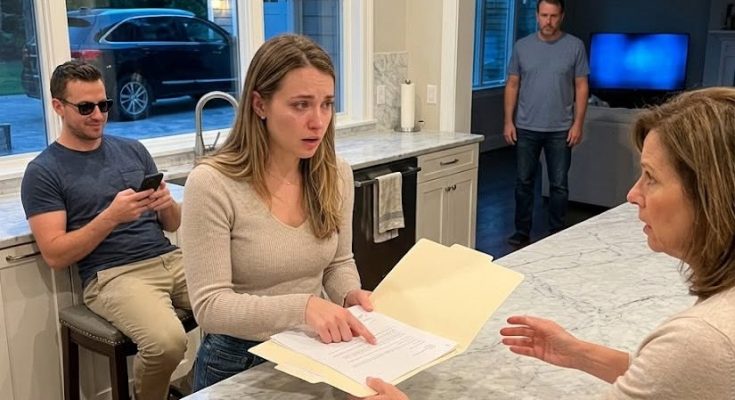
But on that afternoon, standing in my mother’s kitchen, all I knew was that the folder sliding across the marble island felt too smooth for something so ugly.
“Look through it,” my mother said.
“Then stop panicking.”
Her voice had that impatient calm she used when she wanted something terrible to sound practical.
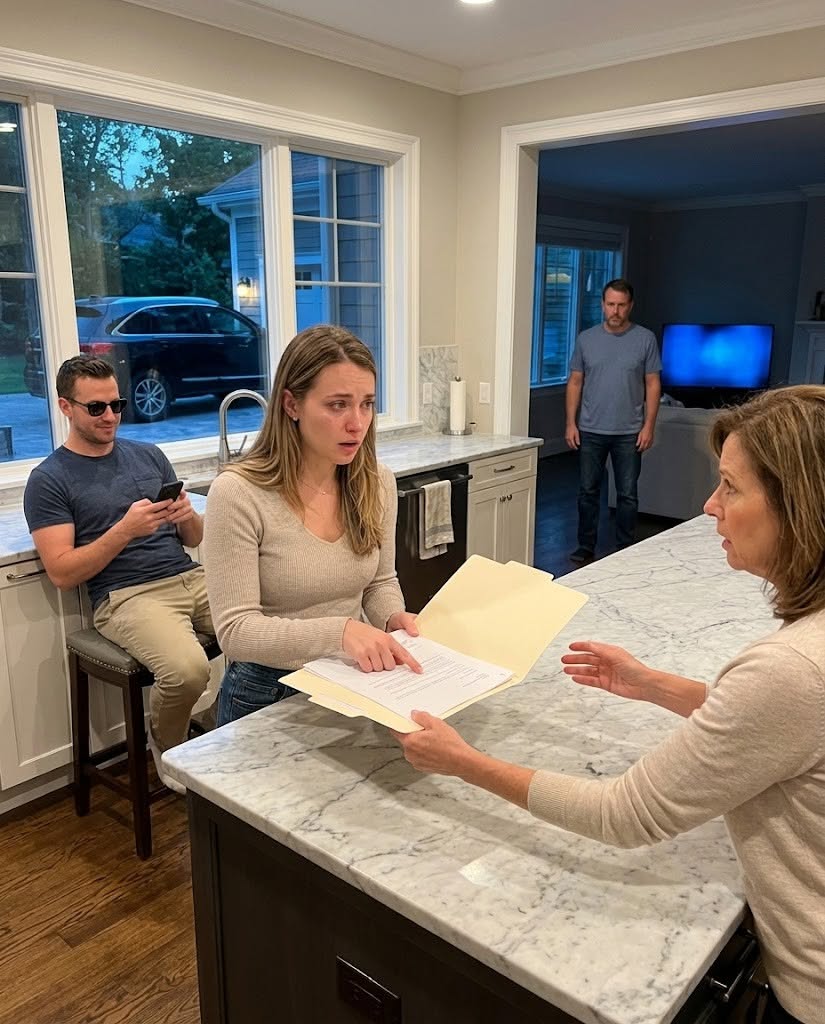
Brandon sat beside her on a barstool, sunglasses on indoors, one ankle bouncing, his phone glowing in his hand.
He looked like he was waiting for a punch line.
My father was in the next room in his recliner, staring at a muted television with the kind of focus cowardly men use when they are trying not to witness themselves.
I looked at the folder, then at my mother.
“You sold Grandma’s house.”
She did not blink.
“The house was sitting there.
Your brother needed help.”
Brandon made a small snorting laugh.
“Here comes the preservation speech.”
Through the kitchen window I could see his black SUV parked at an angle across the walkway, polished and oversized and paid for, somehow, by people who were always asking for help.
For the past month he had been talking about a luxury recovery retreat in Saint Lucia, describing it as though emotional exhaustion were an illness the Caribbean could cure.
My mother had repeated his excuses like scripture.
He’s stressed.
He’s overwhelmed.
He deserves one nice thing.
I had said nothing then, because Brandon always turned embarrassment into performance, and my mother always treated his recklessness like weather.
Temporary.
Unavoidable.
Everyone else should simply adjust.
But Grandma Evelyn’s house was not weather.
That house stood on an oak-lined street in Savannah where the roots pushed up against old brick and Spanish moss softened the air like lace.
Pale blue shutters.
A deep porch.
Floorboards that sighed at night.
A sewing room with west light in the late afternoon and a kitchen that still smelled faintly of cloves no matter how many years passed.
My grandmother had taught me to press flowers at that house, to mend torn paper, to keep letters flat beneath glass, to respect what survives.
I was a document conservator because of her.
I had spent nearly a year restoring the place room by room after her death, not to flip it, not to profit from it, but because it was the only inheritance that had ever felt like love instead of obligation.
“Who signed the sale papers?” I asked.
My mother’s mouth tightened.
“I handled it.”
“That wasn’t my question.”
She pushed the folder an inch closer.
“Your grandmother trusted me with family matters.”
She had trusted my mother to water plants.
To keep the shutters from rotting while probate finished.
To make sure no one stripped the place bare before everything was settled.
She had not trusted her to liquidate it for Brandon’s pleasure.
“The money will go toward his travel debt,” my mother said.
“He’s been under stress.”
Brandon finally glanced up from his phone.
“You don’t even live
there.”
“Because I’ve been restoring it.”
“You were playing museum with dead paper.”
My mother sighed as though I were the exhausting one.
“Alyssa, you have a career.
You have savings.
Brandon is struggling.”
“Brandon booked a trip he couldn’t afford,” I said.
“He needed something to look forward to.”
The room went still.
My father shifted in the other room but did not speak.
I opened the folder.
On top was a purchase agreement.
Beneath it, a seller’s affidavit.
Beneath that, a sheet that made something cold move through my body.
Power of Attorney.
I saw my grandmother’s printed name at the top.
Then I saw the date.
April 2.
My grandmother had died on March 17.
I looked up slowly.
“This is impossible.”
My mother reached for the page.
“Don’t start.”
“Grandma was dead on this date.”
Brandon lifted one shoulder.
“Maybe it was prepared before.
Who cares? The buyer accepted it.”
“A dead woman cannot sign a legal instrument after death.”
My mother grabbed the paper back as though possession could erase the ink.
“You are not going to embarrass this family over an old house.”
There it was.
Not guilt.
Not sorrow.
Fear.
Not of what she had done, but of being seen doing it.
I leaned in toward the signature line.
People think handwriting is decorative.
It isn’t.
It is muscle memory turned visible.
Tiny choices repeated so often they become identity.
Pressure, slant, rhythm, hesitation.
My work taught me that documents carry fingerprints even when no skin remains on them.
The slant was wrong.
The capital E in Evelyn had a pause in it.
The stroke pressure was uneven.
My grandmother’s signature had always moved forward with confidence, a clean sweep under the v and into the final n.
This one looked like someone trying to remember how certainty felt.
“This is not her signature,” I said.
Brandon stopped bouncing his foot.
My mother’s fingers tightened around the folder.
“You think you’re special because you work with old junk?” Brandon snapped.
“No,” I said.
“I think someone used Grandma’s name after she was gone.”
My father finally muted the television all the way.
The silence that followed was thick and ugly.
My mother slapped her palm on the counter.
“Enough.
The sale is done.
Let it go, and I’ll make sure you get a small portion later.”
“A small portion,” I repeated.
Brandon laughed.
“Maybe enough for a plaque.
In memory of Alyssa’s feelings.”
That was the moment something inside me went very quiet.
I pulled out my phone and photographed every page before my mother understood what I was doing.
The purchase agreement.
The affidavit.
The power of attorney.
The date.
The signature.
The notary block.
She lunged.
I stepped back.
“Delete those,” she said.
“I’m warning you.”
“Good,” I said.
“Warnings sound better in court.”
Brandon stood so fast the stool legs scraped against tile.
“You wouldn’t sue your own family.”
I looked at him.
Then at my mother.
Then at my father, who had finally turned his head but still had not found a spine.
“You sold the wrong house,” I said.
I walked out while my mother called my name and Brandon muttered, “She’ll calm down.
She always does.”
Not this time.
I drove straight to Savannah with the folder
images burning in my phone like an open flame.
By the time I turned onto the old street, evening had settled into the branches.
The house stood exactly where it always had, dignified and patient, but a red notice had been taped to the front window.
Property under contract.
Access by appointment only.
I peeled it off carefully and folded it into my bag.
Evidence.
Inside, the air held the closed-up smell of wood, dust, and lavender sachets from another century.
Grandma’s cane still leaned by the hall bench.
Her recipe cards remained bundled with a faded ribbon in the kitchen drawer.
On the mantel, a photograph of us from when I was sixteen waited beneath a veil of dust, both of us squinting into sun.
My phone buzzed.
A text from Brandon.
A screenshot of a beach resort booking confirmation.
Oceanfront suite.
Couples massage add-on.
Private transfer.
Under it he had typed: Thanks for the upgrade, sis.
A second text arrived immediately after, from my mother.
Do not embarrass this family.
We will discuss a fair arrangement after closing.
I screenshotted both.
Then I went upstairs to the sewing room.
If there was one thing my grandmother believed more than sentiment, it was preparation.
She loved beauty, but she trusted paperwork.
She had told me once, years ago, while tucking receipts into labeled envelopes, that kindness without records was just a story waiting to be rewritten by the wrong person.
The writing desk stood where it always had beneath the window.
Cherry wood.
Brass pulls.
A faint ring from a teacup she had promised to polish out and never did.
I opened the shallow drawers first.
Needles.
Thread cards.
Old stamps.
Nothing unusual.
Then I crouched and reached beneath the bottom drawer, where my fingertips found tape.
A cream-colored envelope had been fastened underneath.
My name was written across it in her hand.
Not a copy.
Not a guess.
Her hand.
Strong, slanted, certain.
Inside was a letter, a trust certificate, and a business card for an estate attorney named Julian Mercer.
My eyes landed on a sentence my grandmother had underlined twice in blue ink.
If anyone tries to pressure you, sell without your consent, or use family guilt to take this house, call Mr.
Mercer immediately.
My phone rang from an unknown number.
I answered.
“Alyssa Reed?” a man asked.
“Yes.”
“Julian Mercer.
I was just notified that someone attempted to move title on Evelyn Hart’s Savannah property.
Tell me exactly where you are.”
The whole house seemed to inhale around me.
I sat down on the sewing-room floor and told him everything.
The folder.
The forged power of attorney.
The date after death.
Brandon’s messages.
My mother’s texts.
The trust certificate in my hand.
He listened without interrupting.
When I finished, he was silent long enough for my pulse to start climbing again.
Then he said, very calmly, “Do not leave that house.”
“What?”
“Your grandmother transferred the property into an irrevocable trust six months before she died,” he said.
Papers rustled on his end.
“You are the sole beneficiary and successor decision-maker.
The house was never part of the probate estate your mother had access to.
She could not lawfully sell it.
Not then.
Not now.
Not ever.”