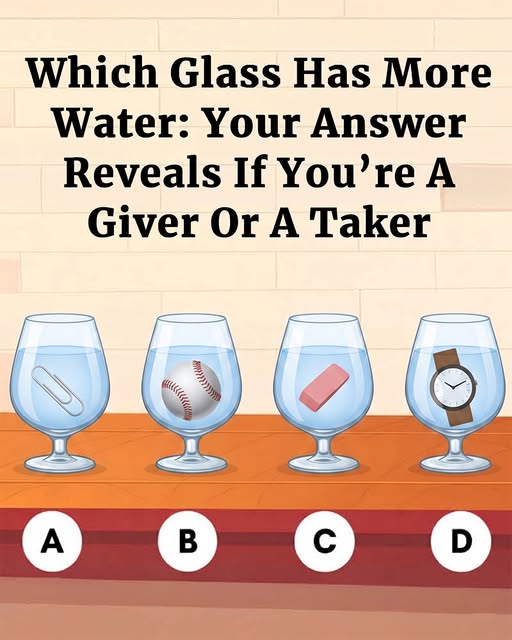

Take a closer look at the setup: four identical glasses labeled A, B, C, and D, each filled to roughly the same level—but each containing a different object: a paperclip, a baseball, an eraser, and a wristwatch.
At first, it feels like a trick question: which glass actually holds the most water?
The instinct for many people is to judge by appearance—but that’s where the twist lies.
 The Simple Science Behind It
When you place an object into water, it pushes some of that water aside. This is called Water Displacement. The larger the object, the more space it occupies—meaning less water can fit in the glass.
So if all four glasses appear equally full, the one with the smallest object must contain the most actual water.
- Glass A: Paperclip (smallest object)
- Glass B: Baseball (largest object)
- Glass C: Eraser (medium size)
- Glass D: Watch (medium-large)
 Correct answer: Glass A holds the most water.
 But Here’s Where It Gets Interesting
While the physics is straightforward, the choice people make often says more about how they think than about what they know.
This kind of puzzle taps into Perception—how we interpret what we see—and even hints at patterns in decision-making.
 What Your Pick Might Reflect
If you chose A (Paperclip):
You tend to notice what others overlook. You’re detail-oriented, patient, and often think a step deeper before deciding. In relationships or teamwork, you may show care in subtle but meaningful ways.
If you chose B (Baseball):
You’re drawn to what stands out immediately. You likely make quick judgments based on visible impact. This can be a strength in fast-paced situations—but sometimes it means missing quieter details.
If you chose C (Eraser):
You lean toward balance. You’re comfortable weighing options and finding middle ground. You adapt easily, often adjusting your approach depending on context.
If you chose D (Watch):
You think beyond the obvious. Meaning, symbolism, and timing matter to you. You might analyze situations more deeply than others—sometimes to your advantage, sometimes to the point of overthinking.
 A Reality Check
It’s worth saying clearly: this isn’t a scientifically validated personality test. It’s a reflective exercise, not a diagnosis. Human behavior is far more complex than a single choice in a puzzle.
But tools like this can still be useful—not because they define you, but because they prompt you to ask:
- Do I rely on first impressions?
- Do I slow down and analyze?
- Do I tend to overthink or simplify?
 Final Thought
The real takeaway isn’t just that the paperclip glass has more water—it’s that what we notice first often shapes what we believe is true.
And sometimes, the smallest detail—the one easiest to overlook—quietly holds the correct answer.